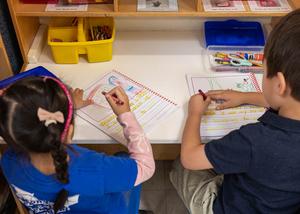
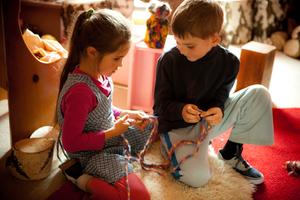
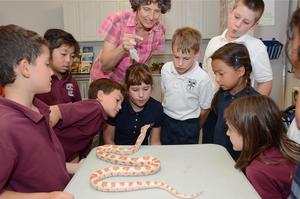
Redbud Montessori mission is to offer children of diverse backgrounds and levels of ability, in a natural setting, a quality non-profit, full-day Montessori program which is integrated with the community, adheres to principles of parent governance and parent/staff involvement and actively subscribes to the teachings of Maria Montessori.
Respect for the unique capabilities and prerogatives of each child are fundamental to a Montessori classroom.
It is equally important for the adults who support that classroom (parents and staff) to present a model to the child of caring attitudes in their dealings with one another.
Redbud wants to help children acquire a sense of common humanity that binds peoples of all races and cultures together so that they might grow up to contribute to a more peaceful and cooperative world.
Redbud wants to help children achieve a powerful sense of "connectedness" with the natural world around them.
Redbud wants to help children achieve a sense of self-respect and pride in their growing competence while at the same time developing their ability to behave in ways that shows respect for other people's interests and capabilities.
Redbud wants to free the child to pursue knowledge and skills most relevant to him or her at a pace that is most comfortable.
Quick Facts (2026)
- School Type: Montessori School
- Grades: Prekindergarten-Kindergarten
- Enrollment: 36 students
- Application Deadline: None / Rolling
- Source: National Center for Education Statistics (NCES)
School Overview
School Type
School Membership(s)School Assoc.
Religious Affiliation
Grades Offered
Grades Prekindergarten-Kindergarten
Year Founded
1984
School Calendar
Campus Size
7 acres
Student Body
Total Students
36 students
Student Body Type
Co-ed
% Students of Color
30%
State avg.: 51%
Students by Grade
Academics and Faculty
Total Classroom Teachers
6 teachers
Student-Teacher Ratio
6:1
National avg.:
Tuition and Acceptance Rate
Admission Deadline
None / Rolling
School Notes
- School Motto: The most important period of life is not the age of university studies, but the period from birth to the age of six…for that is the time when intelligence itself, her greatest implement, is being formed…
- Redbud Montessori mission is to offer children of diverse backgrounds and levels of ability, in a natural setting, a quality non-profit, full-day Montessori program which is integrated with the community, adheres to principles of parent governance and parent/staff involvement and actively subscribes to the teachings of Maria Montessori. Respect for the unique capabilities and prerogatives of each child are fundamental to a Montessori classroom. It is equally important for the adults who support that classroom (parents and staff) to present a model to the child of caring attitudes in their dealings with one another. Redbud wants to help children acquire a sense of common humanity that binds peoples of all races and cultures together so that they might grow up to contribute to a more peaceful and cooperative world. Redbud wants to help children achieve a powerful sense of "connectedness" with the natural world around them. Redbud wants to help children achieve a sense of self-respect and pride in their growing competence while at the same time developing their ability to behave in ways that shows respect for other people's interests and capabilities. Redbud wants to free the child to pursue knowledge and skills most relevant to him or her at a pace that is most comfortable.
Source: National Center for Education Statistics (NCES)
Frequently Asked Questions
What schools are Redbud Montessori often compared to?
Redbud Montessori is often viewed alongside schools like Little Friends Montessori School by visitors of our site.
When is the application deadline for Redbud Montessori?
The application deadline for Redbud Montessori is rolling (applications are reviewed as they are received year-round).
School Reviews
Endorse Redbud Montessori. Endorsements should be a few sentences in length. Please include any comments on:
- Quality of academic programs, teachers, and facilities
- Availability of music, art, sports and other extracurricular activities
- Academic or athletic awards
Recent Articles
Choosing Between a Traditional ²ÝÁñÉçÇø School and a Microschool
Compare traditional private schools and microschools to understand differences in academics, class size, flexibility, cost, and student experience before choosing the best educational fit.
The Second Visit Strategy: What to Look for After the Open House
A second campus visit can reveal what an open house cannot. Learn what to observe, which questions to ask, and how to determine whether a private school is truly the right fit for your child.
How Policy Changes Could Affect Your Tuition Bill in 2026
Learn how federal and state policy changes may affect private school tuition, financial aid, tax benefits, and your family's education budget.